Four Trauma Case Studies Identified $1.7M–$6.6M in Potentially Missed Charges
Four Activate360™ case studies show how connecting trauma registry and billing data can uncover potentially missed charges and support financial review.

What could your trauma registry reveal?
Your registry documents the care your team delivers. But does the claim submitted to the payer tell the same story?
Four Activate360™ case studies show how connecting registry and billing data can uncover potentially missed trauma charges. For finance, revenue integrity and trauma leaders, the lesson is simple: documented care deserves a clear path to financial review.
Close the registry-to-claim gap
Activate360 compares trauma registry encounters with 837 claims to flag potential missing or incorrect charges. In the Northeast example, 835 payment remittances also helped complete the picture.
The findings support hospital review, not automatic claim changes. Teams still need to validate documentation and route supported cases through their rebilling workflow.
Four studies at a glance
Each study covered a 12-month period:
Northeast Level I trauma center
At the Northeast Level I trauma center, registry encounters, 837 claims and 835 payment remittances lived in separate workflows, making it hard to review what happened to each case. Bringing those files together surfaced potential missing or incorrect charges for validation.
- Gross charges identified
- $1.7M
- Estimated net revenue opportunity
- $340K
- Trauma cases evaluated
- 2,701
- Cases confirmed for rebilling
- 246(9.1%)
Southwest hospital system
The Southwest hospital system wanted to know whether trauma activation charges recorded in its registry reached payers. Comparing registry data with submitted 837 claims revealed charges that had been missed.
- Gross charges identified
- $6.6M
- Estimated net revenue opportunity
- $1.3M
- Trauma cases evaluated
- 1,839
- Cases confirmed for rebilling
- 153(8.3%)
Southeast hospital system
The Southeast hospital system had no regular check between registry records and claims for trauma activation charges. Reconciliation produced a list of discrepancies its team could review and address.
- Gross charges identified
- $2.7M
- Estimated net revenue opportunity
- $540K
- Trauma cases evaluated
- 2,430
- Cases confirmed for rebilling
- 521(21%)
South Central hospital system
The South Central hospital system could not confirm that registry-documented trauma activation charges appeared on claims sent to payers. Its first registry-to-claim comparison brought previously unchecked gaps into view for rebilling review.
- Gross charges identified
- $2.1M
- Estimated net revenue opportunity
- $420K
- Trauma cases evaluated
- 1,343
- Cases confirmed for rebilling
- 219(16.3%)
These are charge findings, not collections. Gross charges identified and cases confirmed for rebilling do not establish payment. The studies’ estimated net revenue opportunities assume a 20% payment-to-charge ratio, not guaranteed reimbursement or results for another hospital.
Estimate the potential gap at your hospital
Across these four studies, the charges identified ranged from $1.7M to $6.6M.
Your results depend on your trauma volume, documentation and billing practices.
The Trauma Revenue Calculator offers an illustrative estimate of what may be at stake at your hospital. It is not a prediction of collections.
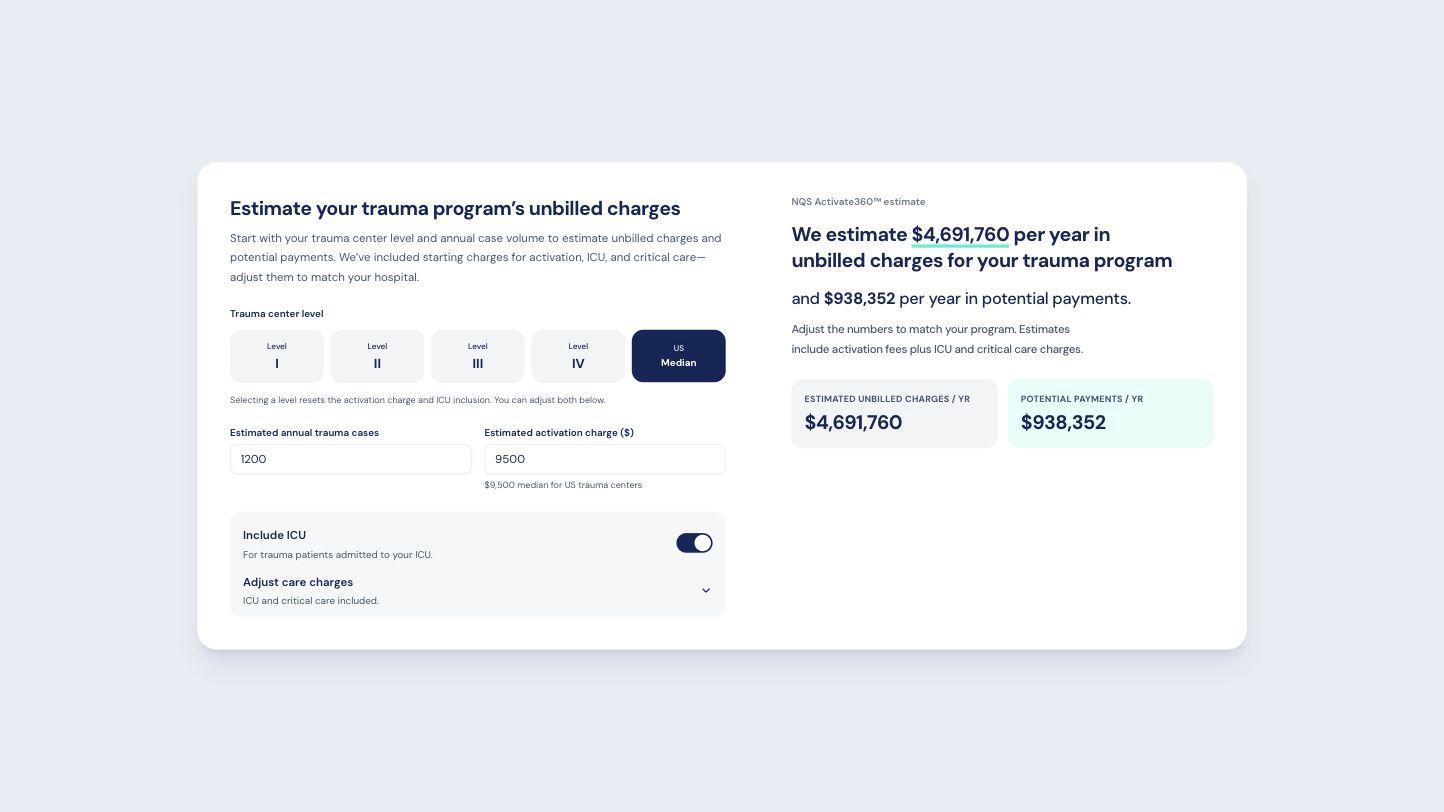
Illustrative calculator example; your estimate will depend on your inputs.
Explore the case studies or book a demo to discuss how your team could review potential gaps.